Walking
Book / Produced by partner of TOW
Walking is the basic way we get around. There is good reason for parents regarding a child’s first step as a significant achievement. When in old age or through an accident our ability to walk is lost, we rightly view it as a major liability. The average person, living to seventy years of age, will walk between 100,000 and 150,000 miles during his or her lifetime.
The Nature and Practice of Walking
Despite its apparent ease, walking is a complex affair. It takes babies up to a year to begin to master it. If we are too self-conscious about it or feel too closely watched, it can become awkward. Actors must learn how to walk on to a stage or set so that the action does not look artificial. After a person has a prolonged sickness or suffers a bad accident, learning to walk again can be slow. Old people may find walking increasingly difficult and hazardous.
Generally, however, in comparison with other forms of movement, once we have mastered walking, we can do it instinctively. In terms of energy in relation to outcome, walking is highly efficient. Since reaction time is almost instantaneous and direction can be changed rapidly, walking has great flexibility. But walking does have its limitations. Its speed is not high, reducing the area we can cover in a given time. Over the long term walking consumes more strength than mechanical means of transport. The very young or old, the physically handicapped or disabled are at a decided disadvantage.
The Divine Benefits of Walking
Yet walking has some real advantages. These stem from its being specially designed and engineered by God as our most natural form of travel.
Physical and psychological effects. In terms of keeping fit, a brisk twenty-minute walk several times a week is as effective as any other form of exercise except swimming. Studies show that walking can help reduce stress, shifts in mood and addictive behavior. It can even increase self-esteem, creativity and sense of control, as well as contribute to our alertness, ability to relax and positive attitude toward life. People who walk tend to have more effective immune functions and therefore remain healthier. Since about half of the decline normally associated with aging springs from underuse or disuse of the body, people who walk regularly also tend to live longer. Many medical professionals now endorse walking therapy for its preventive and rehabilitative effects, especially for those recovering from a heart attack or entering into old age. Even a ten-minute walk boosts energy four times longer than drinking coffee or smoking a cigarette, produces the energy equal to that resulting from eating a candy bar without generating fat or fatigue and uses stress in a positive way to exercise muscles and release tension.
Social and cultural effects. Walking with others, like eating and drinking together, enhances social skills and relationships. It has often had a vital role in establishing—and also maintaining—friendships. As the prophet says, “Do two walk together unless they have agreed to do so?” (Amos 3:3). Down through the centuries walking has also had significant cultural effects. For example, it played a part in the development of early Greek philosophy, especially among the so-called Peripatetics and Cynics. Music, especially its more popular forms, has a debt to the wandering minstrels and troubadours of medieval times. The literary renaissance at the end of the eighteenth century, as embodied in poets like Wordsworth and Coleridge, owed much to the renewed practice of walking. Major essays on the pleasures of walking were written by notable figures of the period.
Spiritual and ministry effects. As many people have found, walking opens numerous possibilities for spiritual enrichment. This is already clear in Wordsworth’s poetry, with its discovery and appreciation of the divine presence in the created world. As the kindred spirit John Findley said, it is not only “a joy in itself but . . . gives an intimacy with the sacred and primal things of earth that are not revealed to those who rush by on wheels.” C. S. Lewis is one of many to have found Christ while taking a walk, for this activity opens up room for deep things to come to the surface. John Wesley found that walking twenty or thirty miles a day not only was health-giving but put “spirit into his sermon.” Although he also traveled on horseback, Wesley would not have been able to carry the gospel to so many people had he not been prepared to walk, as did Paul, Francis and others before him.
Discerning When to Walk
Today walking tends to be a last resort. Faster mechanical means of transportation have lowered its status and pushed it into the background. For the majority of people walking is what you do when you have no other way of getting where you want to go or when another means is just too difficult or time consuming. People will sometimes drive a few hundred yards to shops, school or church, rather than walk. In other words, walking takes place largely by necessity rather than as a proactive choice.
How do we know when we should use God’s most available and natural form of transportation? We must begin by reversing our present attitude. Let us walk wherever we can appropriately do so and only use other means when we cannot. For example, we should walk to close destinations whenever we can conveniently and safely do so. Even if walking takes more time, there are the added physical, psychological and social benefits. When we experience a lot of tension in our lives or our physical capacities are declining, walking can help us relax and stay fit. Many older people find shopping malls ideal for this because of their safety and opportunities for socializing. Also, we can intentionally set aside time to walk with friends and family as a way of building relationships and community. We can also do this occasionally with our colleagues, neighbors and small groups in the church.
Since walking in the countryside or in the city gives us a sense of scale with respect to our own importance, let us regularly make room for this. In doing so we gain a closer knowledge of our immediate and natural environment. Let us also consider how much walking may help us find solitude and opportunities to meditate and converse with God. The more attentive we become to what is around us, the more we shall also receive parables from God. When appropriate, walking around an area may open up ministry opportunities for us and for the congregations to which we belong. It enables people to begin to know who we are and enables us to begin to know them.
Walking as a Biblical Metaphor
The significance of walking appears in other ways, for example, as a metaphor describing some important aspects of life. It is interesting that God is depicted as walking in the Garden of Eden in the cool of the day (Genesis 3:8). Even the Creator delights in taking an evening stroll! God also promises Israel, “I will walk among you and be your God” (Leviticus 26:12). Jesus not only walked all around Palestine—constantly encountering people on the streets and in their homes, places of business and worship centers—but also called people to follow his way of life. For his closest disciples this meant accompanying him wherever he went (Mark 3:14-16), and it was as he traveled that much of their training and much of his teaching and healing took place (Mark 8:31-33; Mark 11:20-25; Luke 8:1-2; Luke 24:13-32). Many of Jesus’ parables also featured people who walked (for example, Luke 8:4-5; Luke 10:30; Luke 13:6).
The language of walking is used frequently in the Old Testament as a picture of the way the people should relate to God. Rather than “walk in the counsel of the wicked” (Psalm 1:1) or “in pride” (Daniel 4:37), they are encouraged to walk with the wise (Proverbs 13:20) and “humbly with your God” (Micah 6:8). In practice this means to “walk according to the law of the Lord” (Psalm 119:1), in his ways (Psalm 119:3) and paths (Isaiah 2:3). For individuals the Lord’s word is a lamp to their feet, which directs their footsteps (Psalm 119:105, 133). To do this is to walk in freedom (Psalm 119:45), uprightly (Isaiah 57:2; compare Isaiah 33:15) and securely (Proverbs 10:9). The model person is one whose “walk is blameless” (Psalm 15:2; Psalm 84:11) and “in the light of [God’s] presence” (Psalm 89:15; compare Isaiah 2:5). No greater compliment could be paid someone in the Old Testament than to say that he or she “walked with God” (Genesis 6:9).
We find similar language in the New Testament. Here too walking is a key metaphor for depicting the way Christians should conduct themselves. John encourages believers to “walk in the light” (1 John 1:6-7; compare John 8:12; John 11:9), as well as in truth, obedience and love (2 John 4, 6-7). For Paul walking is his major way of portraying the Christian life. Based on his own practice of walking, he even fashions a number of miniparables to throw light on different aspects of our pilgrimage. In general we walk in good works rather than worldly ones (Ephes. 2:2, 10), according to the Spirit rather than the flesh (Ephes. 5:8), in “newness of life” not death (Romans 6:4 NRSV), by faith not sight (2 Cor. 5:7), in a proper way rather than a disorderly one (Romans 13:13). More picturesquely he exhorts us to “put shoes on our feet,” that is, take the gospel wherever we go (Ephes. 6:15); to “walk a straight path,” that is, have integrity (Galatians 2:14); to “walk in the light,” that is, be visible Christians (Ephes. 5:8); to walk “in another’s steps,” that is, follow good role models (2 Cor. 12:18); and to “wash the dust off another’s feet,” that is, humbly serve others (1 Tim. 5:10).
The Sacramental Character of Walking
It is clear from Scripture that God can speak to us as we walk so that we can communicate in recognizable ways with others. In view of the richness of the language, it is a pity that most modern translations of the Bible replace the image of walking with more prosaic descriptions such as “live,” “behave” or “conduct yourselves.” While not inaccurate, these translations cut off any imaginative associations that references to walking conjure up. As a result, the already weakened possibility of everyday activities becoming windows to divine realities is diminished even further.
Also affected is our ability to communicate effectively with others—not just because we are encouraged to talk in less concrete, vivid and familiar ways, but because the less we walk, the less contact we tend to have with other people. If we do not walk around our neighborhoods and our cities—Americans, as urban planners know, will generally not walk more than 600 feet from their driveway, parking space or office—we have less opportunity to get to know the people and places around us. One of the main reasons why many neighborhoods and parks have been taken over by gangs and criminals is that ordinary citizens do not walk around them. Most of these could be reclaimed for general, convivial use if we did.
» See also: Body
» See also: Creation
» See also: Health
» See also: Neighborhood
» See also: Public Spaces
» See also: Spiritual Growth
References and Resources
E. V. Mitchell, The Pleasures of Walking (New York: Vanguard, 1948); J.J. Rousseau, The Reveries of the Solitary Walker (Indianapolis: Hackett, 1992).
—Robert Banks





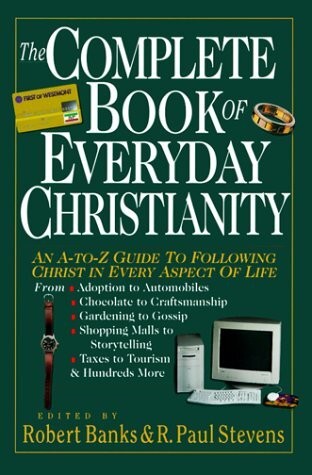
The authors Robert Banks and R. Paul Stevens have partnered with The Theology of Work Project to offer The Complete Book of Everyday Christianity in its entirety here. All rights reserved.
This resource was originally published in 1997, and the text has not been updated.